
We Can Define the Mission. Can We Define Good?

Regardless of department size, budget, or call volume, most organizations demonstrate a strong ability to define their mission. Leaders gather around conference tables to carefully craft statements that reflect service, integrity, professionalism, and commitment to the community. Those statements are printed on challenge coins, displayed in firehouse lobbies, and referenced during recruitment and promotional processes. The fire service has never struggled to articulate why it exists.
That clarity of purpose is important. A well-defined mission provides direction and reinforces the values that bind the profession together. However, when the conversation shifts from purpose to performance, the clarity often fades. Ask a group of firefighters around the kitchen table what good performance actually looks like in their department and the answers quickly begin to vary. One firefighter may emphasize hustle and effort. Another may focus on years of service. Someone else may point to attitude or teamwork. Others may reduce the concept to simply avoiding discipline or staying out of trouble.
What is frequently missing is a shared definition that connects the mission of the organization to observable behaviors that define good performance. Without that connection, mission statements risk becoming aspirational language rather than operational guidance. Departments may know why they exist, yet struggle to clearly describe what level of performance is required to fulfill that purpose. When that gap exists, culture begins filling the space left by the absence of clearly defined expectations.
The consequences of this ambiguity extend beyond simple confusion. When good performance is not clearly defined, it becomes difficult to evaluate fairly. When evaluation lacks clarity, reinforcement becomes inconsistent. Over time, inconsistency leads to cultural drift. Leaders may continue speaking about excellence, professionalism, and dedication, but without behavioral clarity those words become subject to interpretation. Purpose remains inspirational, but it no longer provides direction for daily behavior.
Leadership requires more than defining the mission. It requires defining the standard required to achieve it.
Culture Fills the Vacuum
Organizations rarely remain neutral for long. They either move toward intentional alignment or drift toward informal interpretation. When expectations are not clearly defined and consistently reinforced, culture fills the vacuum. That process rarely occurs through formal decisions. Instead, it develops gradually through repetition and observation. Members watch closely to see what behaviors are corrected and which ones are ignored. They notice who receives praise, who receives protection, and what actions actually carry consequences.
Over time these observations shape the cultural norms of the organization. In combination systems this fragmentation can develop quickly. Career personnel who work together daily may develop one interpretation of acceptable performance, while volunteers balancing outside careers may develop another. One shift may emphasize aggressive training and preparation. Another may lean more heavily on experience and tradition.
These differences rarely develop because firefighters lack commitment. Most members genuinely want to do the job well and serve their communities effectively. The divergence occurs because the organization never unified its definition of good performance. Without that anchor, individuals begin filling in the blanks based on personal experience and historical precedent.
Eventually those interpretations become unwritten standards. Members begin describing them with familiar phrases such as “this is just how we do it here.” While the phrase may appear harmless, it often signals that culture has begun shaping expectations more strongly than leadership has. Policies may exist in binders, but daily behavior within the firehouse reflects the standards that are actually reinforced.
When leadership fails to clearly define good performance, culture defines it instead. Culture left unguided rarely drifts upward on its own.
Informal Leaders and Cultural Influence
Every firehouse contains informal leaders. These individuals may not hold formal rank or administrative authority, yet their influence within the organization is significant. Their credibility is built through experience, operational competence, and years of responding to emergencies alongside their peers. Younger firefighters watch them carefully during incidents, training evolutions, and daily station life.

Because of that influence, informal leaders often shape expectations more powerfully than written policy. New firefighters trying to understand what success looks like do not rely solely on official messaging from officers. They observe the behavior of respected senior firefighters. They watch how seriously those individuals prepare for calls, how they approach training, and how they speak about the organization.
If respected firefighters demonstrate discipline and commitment to preparation, younger members tend to follow that example. Conversely, if preparation is treated casually or training is approached with minimal effort, those attitudes gradually spread through the organization. Modeling carries tremendous weight because it communicates expectations through behavior rather than instruction.
This reality does not diminish the value of informal leadership. When aligned with clearly defined expectations, informal leaders become powerful culture multipliers. Experienced firefighters who demonstrate humility, professionalism, and a commitment to improvement elevate the standards of everyone around them.
Problems arise when expectations are unclear and informal influence fills the void left by leadership. Without clear standards, influence becomes subjective. Over time that subjectivity becomes the operational norm.
Experience and the Risk of Undefined Standards
Experience carries tremendous value in the fire service. Seasoned firefighters bring instincts and judgment developed through years of responding to complex incidents. Many possess the ability to read fire conditions, recognize structural compromise, and maintain calm during chaotic scenes. These lessons cannot be fully replicated in training environments. They are forged through repetition and real-world experience.
However, in organizations where performance expectations remain undefined, a subtle shift can occur. Years of service gradually become the primary measure of competence. Tenure becomes shorthand for credibility and advancement. While respect for experience is deserved, allowing longevity to replace clearly defined expectations creates long-term challenges.
The fire service continues to evolve. Research into fire behavior has reshaped tactics. Building construction has changed how structures fail during fire conditions. Human performance research has expanded our understanding of stress, fatigue, and decision-making under pressure.
If departments fail to define what good performance looks like today, they often default to what it looked like years ago. In a profession that constantly evolves, relying solely on historical precedent introduces risk.
Experience should strengthen performance standards rather than replace them. Veteran firefighters who continue training and adapting demonstrate that experience is not a finish line but a foundation.
The Impact of Tolerated Behavior
One of the greatest risks associated with undefined expectations is the gradual normalization of tolerated behavior. Cultural decline rarely occurs through dramatic events. Instead, it develops through small decisions that seem insignificant at the time. Chronic lateness may go unaddressed. Training may receive minimal effort without correction. Negative conversation within the firehouse may be dismissed as harmless venting.
Members continuously observe how leadership responds to behavior. Over time those observations establish the real boundaries of acceptable performance. Not the boundaries written in policy manuals, but the boundaries leadership consistently enforces.
What leadership allows without correction eventually becomes the standard. High-performing members often recognize this shift before anyone else. They see when extra effort goes unnoticed while minimal effort carries no consequence. Initially they continue pushing themselves, hoping their example will influence others.
If the system fails to reinforce those standards, however, even highly motivated firefighters begin adjusting their behavior to match what the organization truly requires. Initiative declines. Innovation slows. Mentorship becomes less frequent.
Undefined expectations therefore do not simply protect poor performance. They discourage excellence.
Defining Good Is Leadership Work
Defining good performance does not require thicker policy manuals or complex evaluation systems. It requires behavioral clarity and consistent reinforcement.
Operationally, good performance may include arriving prepared before the tones sound, knowing assignments without prompting, and communicating clearly during emergency operations. It may involve maintaining equipment readiness and committing to training beyond minimum requirements.
Culturally, good performance includes protecting the reputation of the department, mentoring newer firefighters, and contributing solutions instead of complaints. Personally, it includes maintaining physical readiness, regulating emotional responses under stress, and accepting responsibility when mistakes occur.
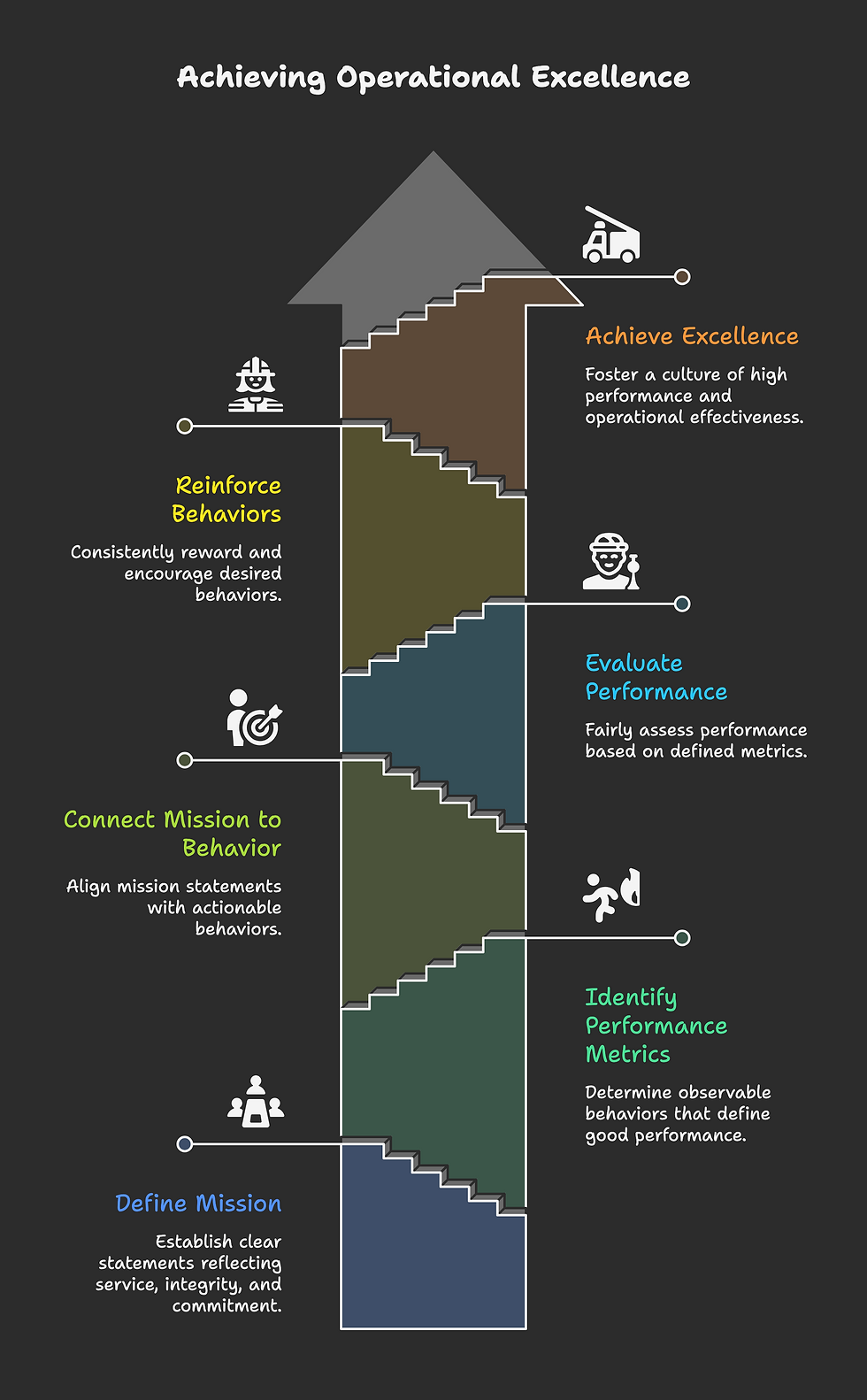
These expectations are not abstract ideals. They are observable behaviors that can be reinforced and measured. When leaders define performance in behavioral terms, conversations about accountability become clearer and more consistent.
Clarity communicates respect. It tells members that leadership values their professionalism enough to clearly articulate expectations rather than leaving them open to interpretation.
Define It Before the Tones Drop
The fire service asks its members to perform in unforgiving environments. Structure fires evolve rapidly. Vehicle extrications demand technical precision. Medical emergencies require decisive and coordinated action. These incidents occur infrequently, yet when they happen the consequences of error are significant.
Departments expect firefighters to operate with discipline and composure under those conditions. Such expectations cannot begin when the apparatus bay doors open. They must be established long before the tones drop.
If organizations expect disciplined performance during crisis, they must define disciplined behavior during routine operations. Members should understand what good performance looks like during training, daily responsibilities, and professional interactions.
Mission statements describe why the fire service exists. Clearly defined performance standards determine whether departments are worthy of that mission. If organizations speak about excellence, they must describe the behaviors that demonstrate excellence.
If leaders fail to define good performance, the organization will eventually define it through what it tolerates.
The fire service does not struggle with purpose. The men and women who serve understand why they wear the badge. What organizations often struggle with is clarity regarding performance expectations.
When the tones drop again, firefighters should not be guessing what good looks like.
They should already know.


Comments